

Are hotspots of evolutionary potential adequately protected in southern California?
Vandergast, A.G., Bohonak, A.J., Hathaway, S.A., Boys, J., and Fisher, R.N. 2008. Are hotspots of evolutionary potential adequately protected in southern California? Biological Conservation 141: 1648-1664. U.S. Geological Survey and San Diego State University.
What it found about Warner Springs
- Warner Springs is the largest hotspot of genetic divergence in the study's multi-species map of southern California: an area where populations of many animal species are unusually different from one another genetically.
- It sits where several mountain ranges meet the desert, with a steep rainfall gradient and the San Jacinto fault zone.
- The authors say wildlife connectivity could be extended through this hotspot, from the foothills of the San Bernardino Mountains to Palomar Mountain and the Santa Ana Range.
- In 2008 about half the region was unprotected. The largest unprotected piece was in the north, the foothills and valleys just south of the San Bernardino National Forest.
What it does not support
- It maps broad regions, not exact locations. The authors say so themselves.
- It uses existing mitochondrial DNA studies of 21 animal species. It is not a survey of every species on a right-of-way.
- It is not a model of extinction. It does not say building a line would wipe out species.
- It does not address fire. Fire is a separate argument with its own evidence.
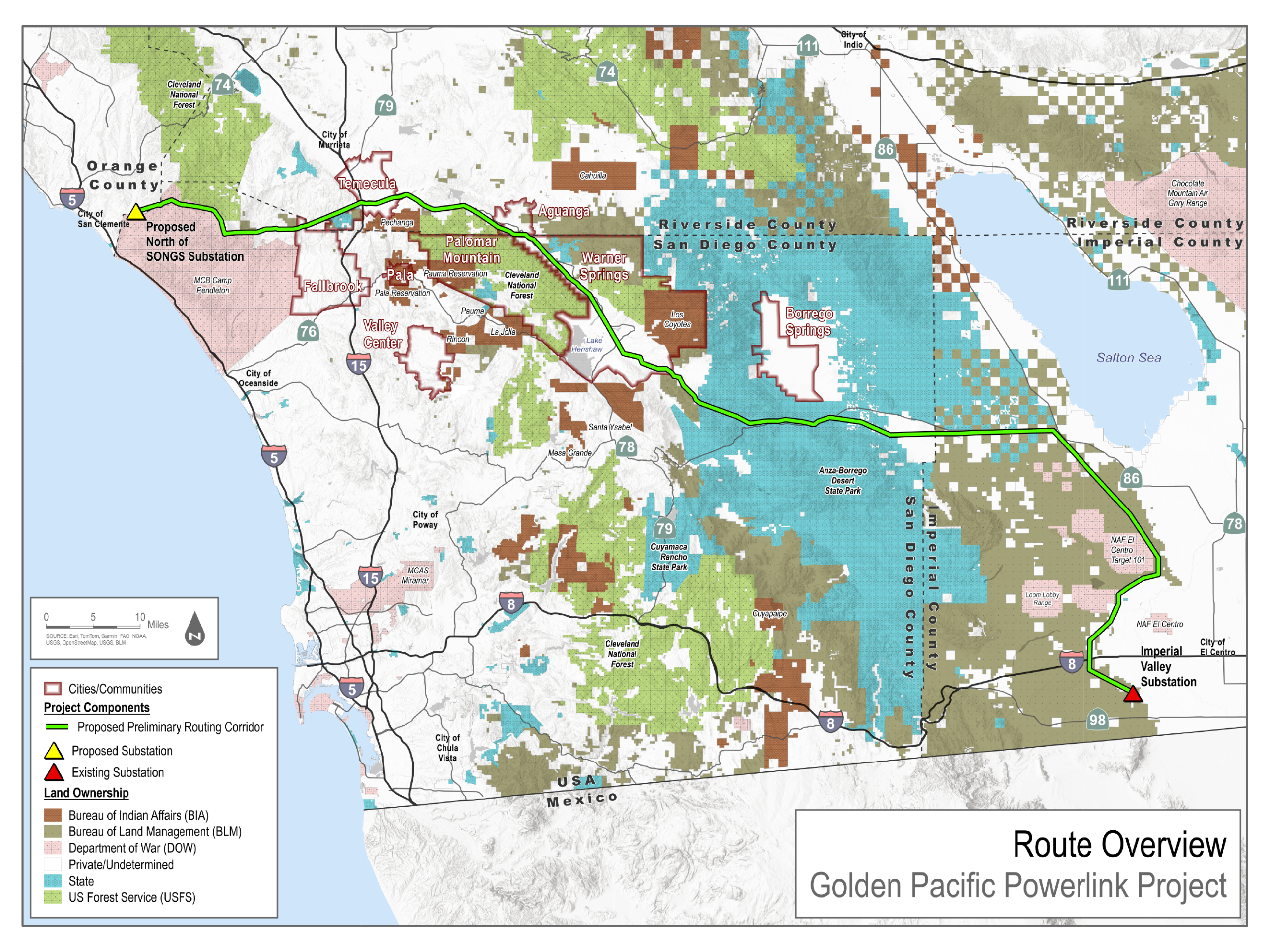
The Vista Irrigation District says every route SDG&E has shown crosses the District's land at Warner Springs, on an easement 200 to 250 feet wide. SDG&E says access to build and maintain the line may include new roads and helicopter landing zones. That is a permanent corridor through the connectivity this paper says is worth protecting. That is the claim the paper supports, and it is strong enough on its own.
Sources: Vista Irrigation District; SDG&E
We link to the publisher and to the USGS record rather than posting the paper, because the publisher does not allow copies to be reposted.